About the Site

A Brick Universe That Outlived Empires

History

The Long Life of a Bengal Monastery

Shalban Vihara was established in the early 8th century CE — most likely under the patronage of King Sri Bhavadeva of the local Deva dynasty — as a self-contained monastic university. Across the next six centuries, it would be refurbished, expanded, and renewed under successive royal houses: Devas, Chandras, and the wider Pala-era Buddhist polities of eastern India.

What emerged was not a single monument but a sequence of monuments, layered one upon the other on the same red-soil hilltop — bricks recycled, plans extended, the central shrine reshaped each time the community's needs evolved.

By the 13th century, with the political reordering of Bengal and the steady contraction of organised monastic Buddhism in the eastern subcontinent, the vihara fell silent. Yet its bricks, courtyards, and enclosing walls quietly persisted beneath centuries of soil, awaiting the slow reawakening of modern archaeology.

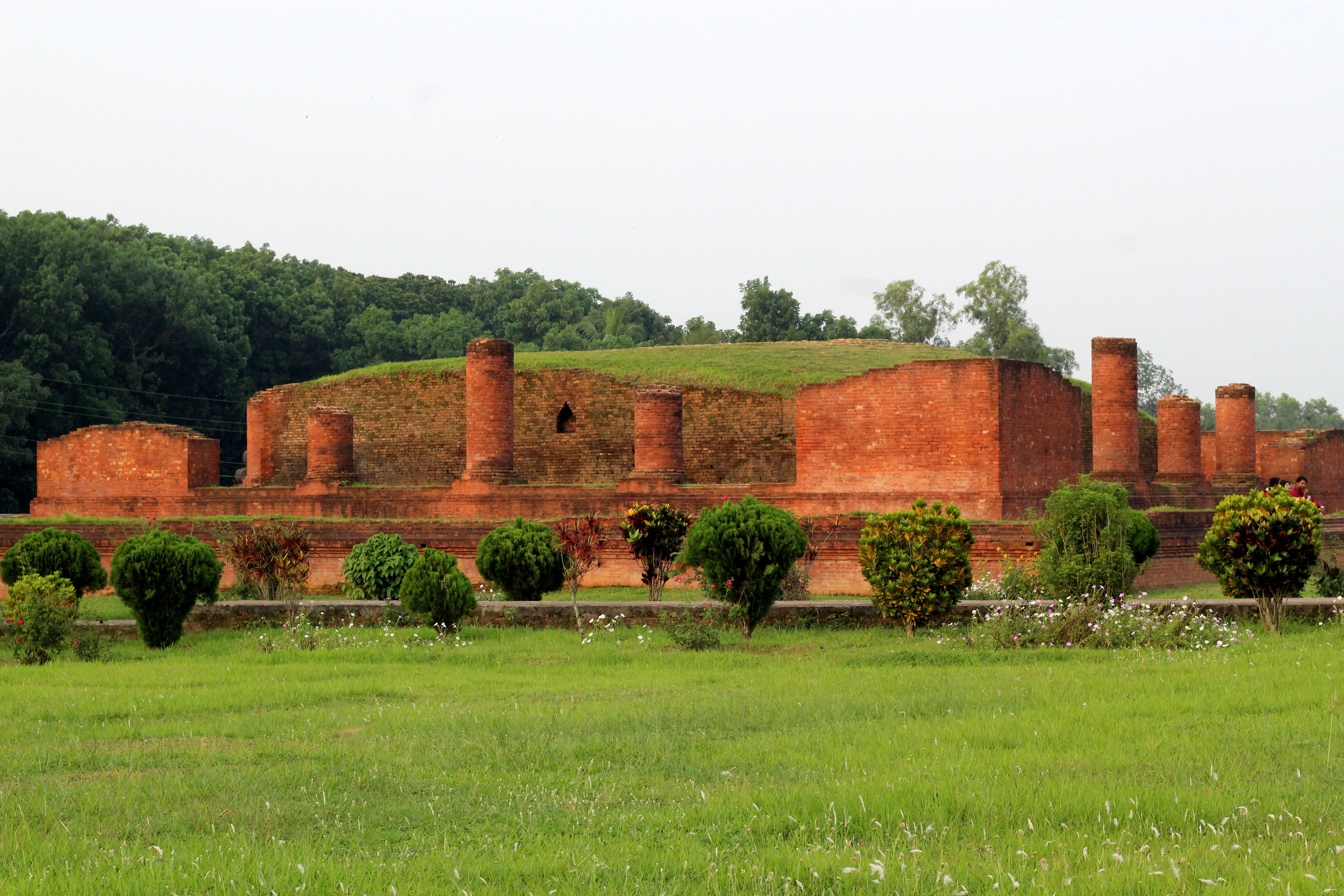
Brick walls and architectural detail of Shalban Vihara
Location

On the Red-Soil Ridge of Moinamoti

The vihara stands on the western flank of the Moinamoti–Lalmai ridge in the Cumilla district of southeastern Bangladesh, roughly 8 kilometres from the city of Cumilla and approximately 100 kilometres east of Dhaka along the Dhaka–Chattogram corridor.

This ridge — rising gently above the surrounding paddy plains — provided ideal monastic terrain: dry, elevated land near important river routes, with quiet hill enclaves that suited contemplation while remaining well-connected to the ancient inland trade networks of eastern Bengal.

The site sits within a sacred archaeological landscape that includes Kotila Mura, Charpatra Mura, Itakhola Mura, and the on-site Mainamati Museum — a coordinated heritage cluster that has no parallel elsewhere in Bangladesh.

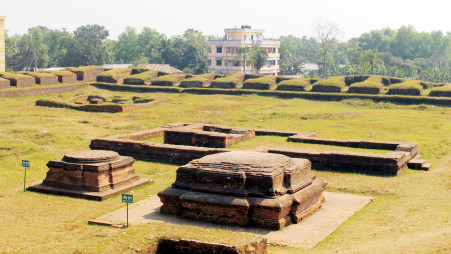
Aerial perspective of Shalban Vihara on the Moinamoti ridge
Discovery & Excavation

From Buried Ridge to Recognised Monument

The modern story of Shalban Vihara begins in the 1870s, when colonial surveyors first registered the Moinamoti mounds. Systematic excavation, however, would wait nearly a century.

1875 – 1944

Early Surveys

British colonial officers and the Archaeological Survey of India recorded the Moinamoti mounds as potential ancient sites, but no formal excavations were undertaken at Shalban Vihara during this period.

1955 – 1957

Pioneering Excavations

The Department of Archaeology of the (then) Government of East Pakistan began the first systematic excavations across the Moinamoti–Lalmai ridge, exposing substantial portions of Shalban Vihara's quadrangular plan.

1958 – 1986

Stratigraphic Reading

Successive seasons identified seven major building phases, recovered copper-plate inscriptions, and produced the bronze and terracotta corpus that today defines our understanding of monastic life on the ridge.

1987 – Present

Conservation & Continuing Research

Under the Department of Archaeology of Bangladesh, the site has been progressively conserved, opened to scholars and visitors, and integrated into national and international heritage frameworks.

Six Centuries of Activity

Operating from the 7th to the 12th Century CE

Shalban Vihara was not a static monument but a living institution — refurbished and renewed across the entire arc of Bengal's classical Buddhist age.

The Foundational Phase

Established under Sri Bhavadeva of the Deva dynasty in the early 8th century CE, the original vihara was modest in scale — a quadrangular brick monastery designed around a central courtyard with an open shrine.

The Chandra Re-foundation

Under the Chandra dynasty in the 10th–11th centuries, the central shrine was rebuilt in cruciform plan and the residential cells were extensively refurbished, marking the monastery's most ambitious architectural moment.

Pala-Era Networks

Scholarly and ritual links with the wider Pala monastic ecosystem — Nalanda, Vikramashila, Somapura — placed Shalban Vihara firmly within the eastern Buddhist learning network.

The Quiet Withdrawal

Through the 12th and into the 13th century, monastic activity gradually contracted, the site fell into disuse, and the bricks were reclaimed by the soil — preserved beneath the ridge until modern archaeology reopened them.

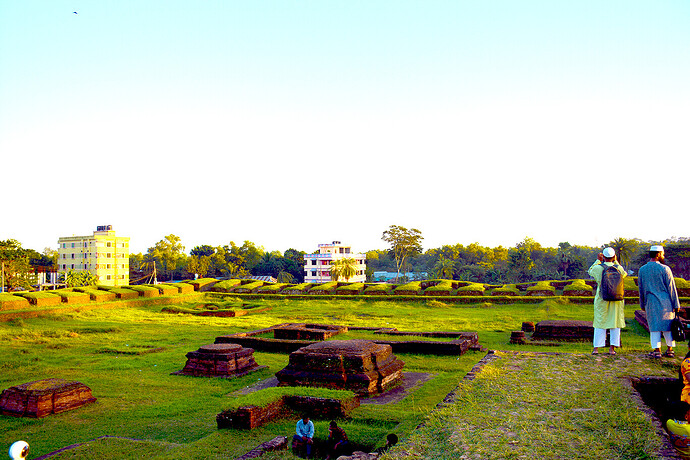
Central shrine of Shalban Vihara seen across the courtyard
Role as a Monastery

A University of Stillness, Study & Service

Shalban Vihara functioned simultaneously as a residence for ordained monks, a teaching institution for novices, a workshop for the production of icons and manuscripts, and a pilgrim destination for the lay Buddhist community of Bengal.

Daily life at the vihara was organised around a sequence of ritual hours — morning chants, study sessions, meditation, communal meals, and the formal recitation of the Vinaya — patterns inherited from the great Indic monastic traditions and adapted to local Bengali Buddhist practice.

Above all, it was a place where the Buddha-dharma was preserved and transmitted at the very edge of the eastern subcontinent — a frontier institution that sustained the contemplative life of an entire region.

Importance in Bengal Buddhist History

One Monastery, Many Inheritances

A · Architecture

Predecessor of Paharpur

The cruciform shrine and quadrangular monastic plan at Shalban Vihara directly anticipates the design language perfected at Somapura Mahavihara (Paharpur) — making the site a critical link in Bengal's monastic architectural lineage.

B · Patronage

A Royal Sanctum

Copper-plate inscriptions found in and around the site name the Deva and Chandra rulers as patrons, anchoring the vihara within the dynastic and devotional histories of early-medieval southeastern Bengal.

C · Iconography

A School of Eastern Buddhist Art

The bronze and terracotta corpus produced here — Bodhisattvas, Tara figures, and meditational deities — defines a regional school of Bengal Buddhist sculpture distinct from, yet conversant with, that of Bihar and the wider Pala world.

Connection to Regional Vihara Networks

A Node in the Eastern Monastic Web

Shalban Vihara was never an isolated cloister. It belonged to a tightly woven network of viharas across eastern India and Bengal — Nalanda and Vikramashila in Bihar, Somapura in northern Bengal, the Moinamoti–Lalmai cluster itself, and the riverine monasteries of the Brahmaputra–Meghna delta.

Monks moved between these institutions; manuscripts and ritual texts circulated; and ideas — Mahayana doctrine, tantric practice, philosophical commentary — passed from one community to another through this living scholarly network.

Explore the Buddhist Legacy
Excavated brick monastery with surrounding monk cells
Cultural & Archaeological Significance Today

A Heritage of Contemporary Consequence

For modern Bangladesh, Shalban Vihara is more than an archaeological site — it is a civilisational point of reference. Its preservation reaffirms a Buddhist heritage that was once central to the cultural life of the Bengal delta, and its presence on the global heritage map invites a deeper, more nuanced reading of the country's pluralist past.

For South Asia at large, the vihara stands alongside Nalanda, Paharpur, and Vikramashila as one of the great monastic universities of the eastern Buddhist world — a link without which the regional history of Buddhism cannot be fully written.

UNESCO
Tentative List Tradition
National
Protected Monument
115
Monk Cells
7
Building Phases
Management & Cultural Stewardship

Custodians of the Heritage Programme

A small, principled circle of advisors guiding the contemporary visibility of Shalban Vihara and shaping its participation in Indo–Bangladesh and BIMSTEC cultural-heritage frameworks.

Portrait of Digant Sharma

Cultural & Heritage Ambassador

Digant Sharma

Entrepreneur · Social Architect · Nation-Building Strategist. Founder of the Torus Group and Co-Founder, Bangladesh Cultural Heritage Trust — leading the Shalban Vihara visibility programme through CSR, government engagement, and digital infrastructure.

Read Full Profile
Portrait of Rahul Laxman Patil

Regional Youth Engagement & Cultural Affairs · Track-II Diplomacy Strategist

Rahul Laxman Patil

Advancing civilisational dialogue, cultural geopolitics, and Indo–BIMSTEC regional integration. Lead contributor to the Tri-Nation Tri-Services Lord Buddha Circuit Motorcycle Expedition.

Read Full Profile